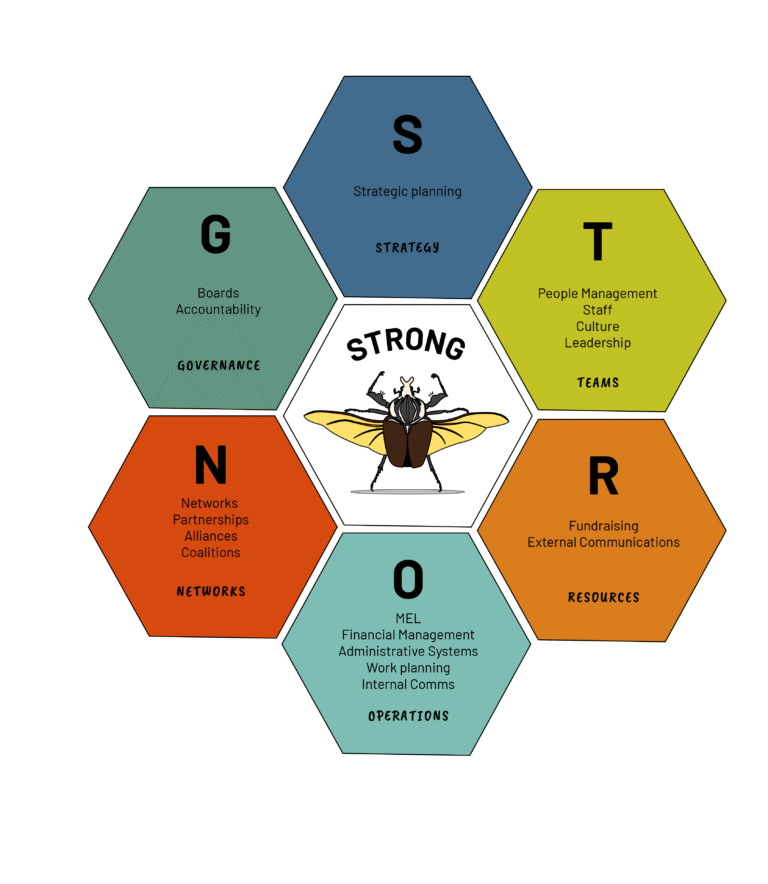
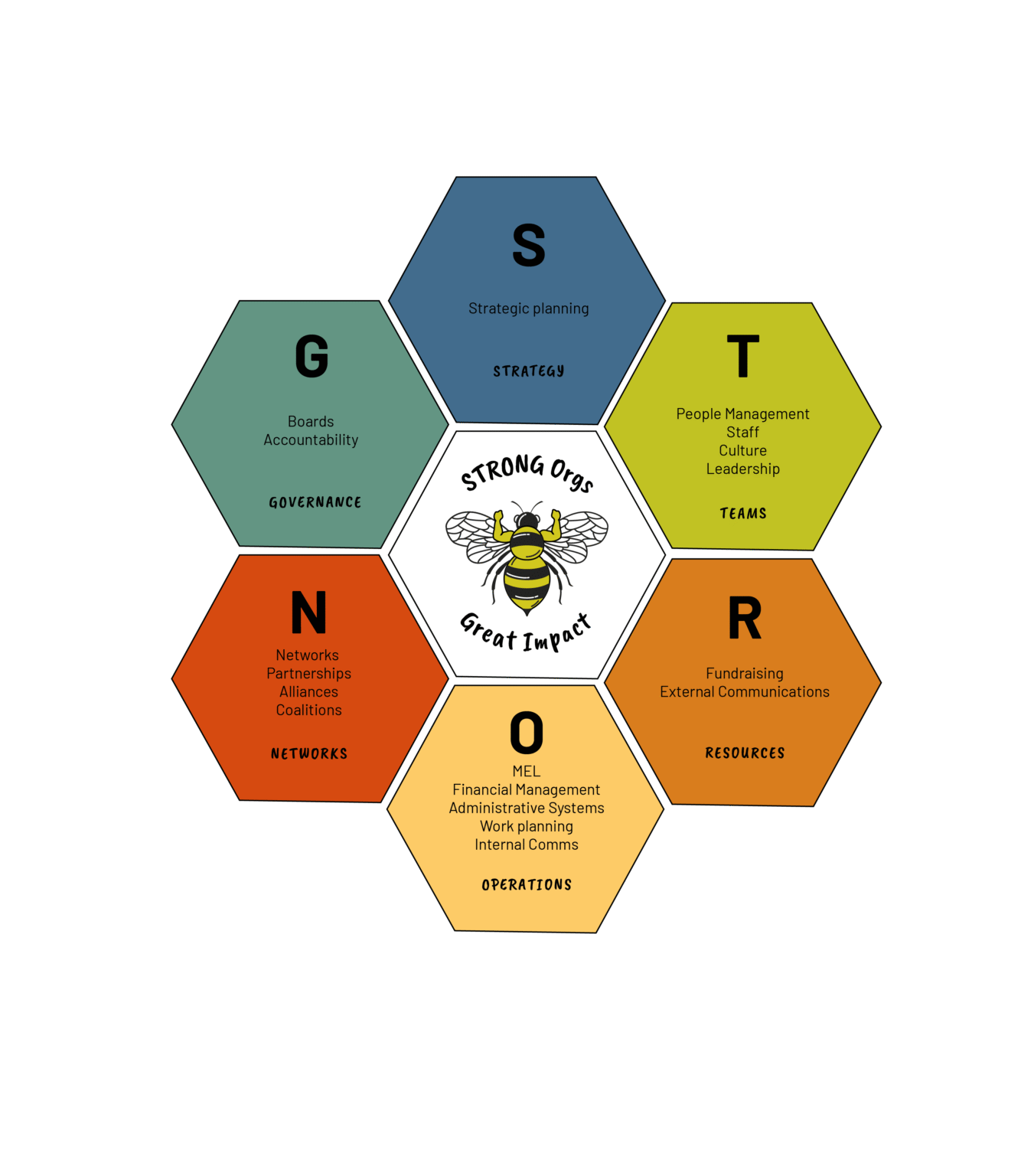
| At Maliasili, we’ve spent the past 15 years learning the answers to those questions alongside our partners. Through our efforts to strengthen our partners, we’ve continually refined our approach to understand what truly makes organizations effective: the systems, the people, the vision, the culture, and the leadership that enable organizations to deliver outsize impact. These 15 years of experience, engaging with more than 100 organizations across Africa and beyond, have informed our new STRONG framework.
Like any framework, the purpose of STRONG is to distill and simplify complex ideas and relationships in a user-friendly way. In all our work at Maliasili, we strive for simplicity and clarity, and believe that STRONG can help leaders focus on some of the most critical areas for organizational performance, which is in and of itself a critical step in becoming stronger and more effective.
Note: STRONG is a framework for building a strong and effective organization; but that’s only one side of the equation. On the other side is the work itself: delivering meaningful, high-quality results on the ground, rooted in the realities of the communities and landscapes you serve. A strong organization enables you to do that work better, to sustain it, scale it, and deepen its impact. |
| As we dive into the framework, each section includes a few questions to prompt your thinking and help you to think about where your organization is thriving, where it needs more focus, and where there may be gaps that need attention. There is no hierarchy to these six fundamentals, and they apply to organizations of every size and stage, but a clear strategy and a talented team of people are essential foundations and often places to start.
The goal isn’t to reach perfection in every area (wouldn’t that be ideal!), but to build awareness of where your organization stands, strengthening what’s working and addressing what isn’t before it becomes a bigger issue. There is also no single “right way” to apply these principles; each organization’s journey will look different depending on its context and realities. What matters most is being aware, intentional, and consistently nurturing these foundations.
|
|
| Strategy lies at the center of an organization’s identity, purpose, and aspirations to achieve impact. An organizational strategic plan is an important framework for expressing why an organization exists, what it wants to achieve, and what priority initiatives or actions and resources will enable it to fulfill its mission and ambitions. Strategy connects purpose and mission with clear goals and priorities, and the organizational capacity and resources that are needed to deliver. Strategy provides focus and clarity, thus underpinning efforts to communicate about an organization’s work, define success, and mobilize resources.
Reflective questions:
- Can your organization clearly explain the problem it’s trying to solve and what success looks like?
- Does your strategy guide how you allocate your time and resources?
- Can your whole team confidently articulate your core strategic goals and priorities?
“We didn’t have any strategy for the organization. I wasn’t formal, in terms of the structure of the organization or the running of the organization. But that has shifted, becoming more formalized, more coordinated, and things started coming together. The organization began to grow and take shape, and a culture started to develop as we developed our strategic plan.” Dr Moreangels Mbizah, Executive Director, Action pour la conservation de la faune sauvage
“The development of our five-year strategic plan was a real turning point. It aligned people’s thinking and gave us focus. Before that it was mostly my way of thinking; now it’s our collective vision.” Richard Moller, CEO, Tsavo Trust
|
|
|
|
For any social change organization, its people – operating as a high-performing team – are its most critical resource. Great teams, with strong leadership, a healthy and dynamic culture, and the management practices that underpin effective teamwork and collaboration, are fundamental to any organization’s success. The top job of any organizational leader is to assemble, develop, and forge an outstanding team out of its individual people.
Reflective questions:
- Do your people have clear roles and understand how their work supports the organization’s strategy?
- Does your leadership provide clear direction while creating space for feedback and learning?
- Does your organization invest in developing future leaders and cultivating a strong, values-driven culture?
“I can’t swap my team for any other. It’s a young, energetic, super team, and that’s not just me saying it. Partners tell me, ‘Alfred, you weren’t there for the meeting, but your team did a fantastic job.’ That’s what I’m proud of: people stepping up, taking ownership, and delivering even when I’m not in the room.” Alfred Mwanake, CEO, Association des conservancies de faune sauvage de Taita Taveta (TTWCA)
“When we hired the right people and trusted them, they did their jobs better than I ever could. That was thrilling; that’s when I knew we’d reached a new level.” Andrew Stein, Executive Director, CLAWS
|
|
|
|
Every organization requires the right financial resources in order to do its work, including recruiting and investing in the right people as well as key infrastructure. Securing a healthy portfolio of funders, ideally ones that provide flexible and long-term support, requires strong communications that convey an organization’s vision and strategy as well as its impact and achievements.
Reflective questions:
- Does your organization have a diverse funding portfolio with a balance of core/unrestricted and program/restricted support?
- Are your financial systems strong enough to track, report, and plan effectively?
- Are you cultivating deep, long-term relationships with funders who believe in your vision?
“Having unrestricted funding changed how we operate. It gave us flexibility to innovate, plan long-term, and build systems… things we couldn’t have done under restricted budgets.” Andrew Stein, Executive Director, CLAWS
|
High-performing organizations are defined by operational excellence, they use their resources to deliver on their priorities and execute on their goals. Simply put, they get stuff done and they do it well. They have the right systems for organizing their work and people, including key areas of administration, financial management, work planning and prioritization, and internal communications. They have strong processes of monitoring and evaluation, which provide the feedback loops telling them if and how they are advancing towards their goals or if they need to course-correct.
Reflective questions:
- Does your organization have an annual work plan and budget aligned with your strategic plan?
- Do you regularly review your progress and adjust based on what you learn?
- Are your systems, policies, and procedures clear, accessible, and consistently followed?
“Before, we did everything ad hoc. We had cars but no logbooks, no SOPs, no structure — we’d literally just jump in and drive, and then run out of gas because no one remembered to write down that the gauge didn’t work. That’s what it was like across the board. We were accomplishing a lot, but in ways that weren’t sustainable.
Working with Maliasili gave us guidance to professionalize without losing who we are. Now we have systems for everything: finance, HR, MEL, operations, management reviews — and it’s completely changed how we function. The management training we did, bringing all our site managers together for the first time, was a turning point. It gave people clarity on their roles and gave me space to focus on strategy instead of trying to do everything myself. Having a deputy director completely changed the game. I honestly don’t know how we functioned before.” Matt Becker, CEO, Programme des carnivores de Zambie
|
|
|
|
Great organizations are never an island unto themselves. Organizations that are ambitious and successful invariably are exceptionally good at working with others, through strong and diverse networks that form the foundation for a range of supporters, allies, partnerships, and different types of collective action. These constellations of contacts and collaborators are critical to both delivering on an organization’s mission and for securing the resources it needs to thrive.
Reflective questions:
- Does your organization have a strong culture of collaboration with others?
- Are your partnerships helping you extend your impact and learn new ways of working?
- Does your leader/leadership actively cultivate relationships that open doors for influence and resources?
“It’s one thing for an organization to exist for years, but another for communities and partners to actually recognize its value. For us, that recognition now comes from all sides, the county government, KWS, WRTI, Tsavo Trust, even the national government. We’ve reached a level where people say, ‘TTWCA is a valuable partner.’ That’s a big shift.” Alfred Mwanake, Executive Director, Taita Taveta Wildlife Conservancies Association (TTWCA)
|
|
|
|
A final key foundation for organizational success is strong governance. Organizations need to have strong underlying processes and accountability for making decisions and using their resources, including grounding their work in their constituencies. Boards of Directors or Trustees play a key role in overall governance and leadership and providing that accountability to mission and purpose.
Reflective questions:
- Does your board play an active role in shaping strategy and holding leadership accountable?
- Are there clear accountability mechanisms in place for critical elements of organizational efficiency?
- Does it help raise the organization’s visibility and resources?
- Are roles between board and management clear, with the right balance between strategy and operations?
“To be honest, when I started, I didn’t even really know what a board was. I was a biologist, and my understanding was just that you have to have one, hold a meeting once a year, and tick that box. In the early years, the board was very supportive, but they didn’t get involved in operations, which probably helped us grow quickly because we could just get on with things.
But as the organization matured, I realized we weren’t using them to their full potential. We have a really talented board with a lot of experience, and they felt underutilized for a long time. With Maliasili’s guidance, we started figuring out how to actually engage them — how to structure the board, clarify roles, and make use of their skills. It’s still a work in progress, but now it’s becoming a real asset for the organization rather than just an obligation.” Matt Becker, CEO, Zambian Carnivore Programme |
|
|
|
Building a STRONG organization doesn’t happen overnight. It’s a journey of reflection, learning, and growth. The most resilient organizations are those that consistently pause to assess how they’re doing across each of these areas, celebrating their strengths and identifying where they can grow next.
|
|
|
|
|
|
|