
For many, inspiration rarely arrives neatly. It comes in the middle of a long drive, in the pages of a book passed on by a colleague, a song, or in a conversation that lingers long after it ends. Inspiration is quietly personal; shaped by who we are, what we value, and what we’re reaching towards. […]
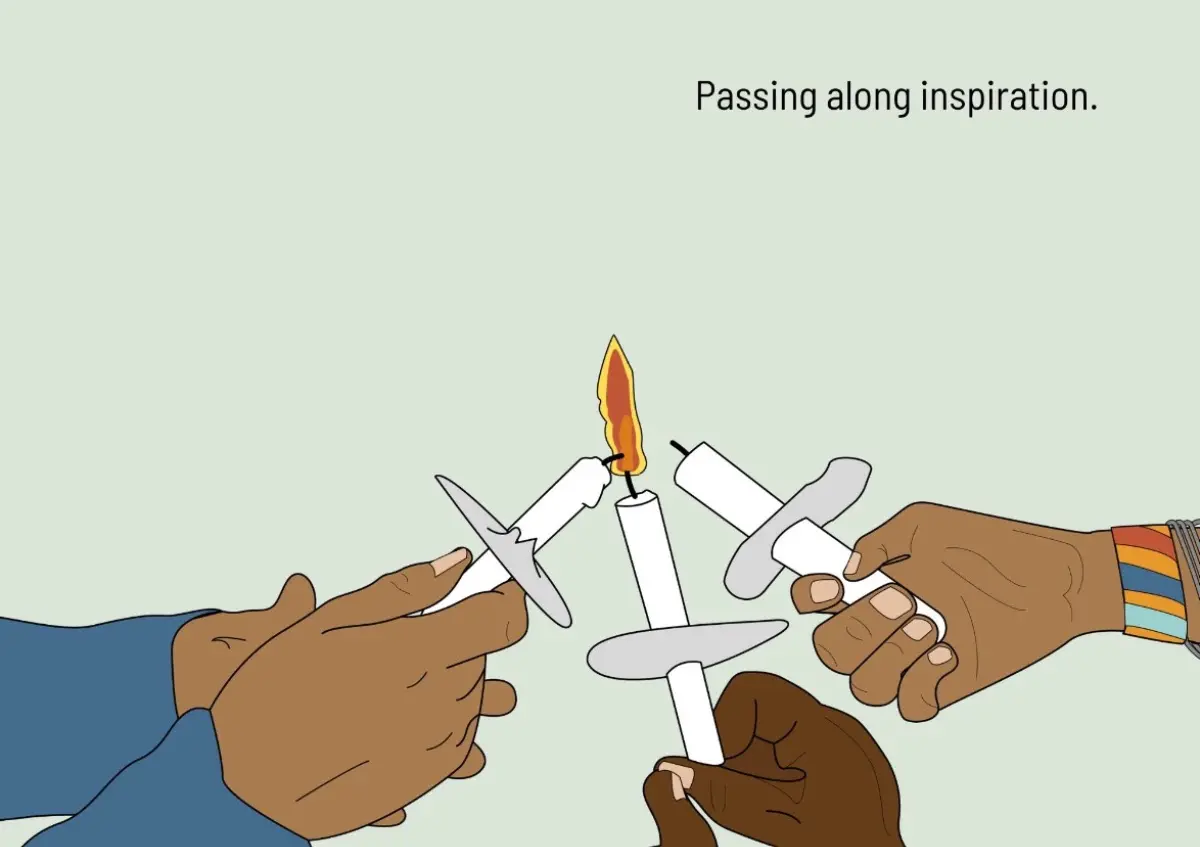
For many, inspiration rarely arrives neatly. It comes in the middle of a long drive, in the pages of a book passed on by a colleague, a song, or in a conversation that lingers long after it ends. Inspiration is quietly personal; shaped by who we are, what we value, and what we’re reaching towards. Here, a few leaders and Maliasili team members share what is shaping their thinking right now, and we hope it sparks something in you, too.
I get inspiration from all sorts of places, but I recently read something that has made me think differently and deeply about a specific piece of work I am running with our team – what it takes to do our work better. This year, we are getting much more intentional about internal learning and growth in Maliasili. One way we do this is through the personal learning and growth goal we ask our team to set for themselves each January, and another is our annual team retreat – both create space to reflect and refocus on how we can better support our partners.
So I have been thinking a lot about what really makes learning happen and what systems we can build to support our team to truly learn and grow.
I recently picked up Hidden Potential by organisational psychologist Adam Grant. In the first chapter, “Creatures of Discomfort,” he talks about “embracing the unbearable awkwardness of learning” which sounds a lot like the stretch we are trying to support. His account of people learning new languages hit home: he notes that “comfort in learning is a paradox” and that the anxiety we feel on the way to mastering something is exactly why we avoid it.
But the real aha moment came with this: “Accelerating learning requires a second form of courage: being brave enough to use your knowledge as you acquire it.” As leaders, our job is to nudge our teams to practice hard things, to be safe in discomfort, and to celebrate the attempt – even when it goes wrong. I’m still thinking about how we build a culture with scaffolding and systems that encourage our team to go to their uncomfortable edge and give new things their best shot.
If you are keen to hear more, this is a great podcast on “Why Discomfort is the Key to Growth” Adam Grant on On Purpose with Jay Shetty.
We recently launched our new Strategic Plan. During the launch, my colleague Janet Matota spoke about her journey as one of the first female community resource monitors in the early 1990s, when conservation was, frankly, not a space that welcomed women. Janet and I work together, we talk often, and I thought I knew her story. But hearing her reflect on it openly – the barriers, the moments she could have walked away, how she found her way through the challenges, her courage – I found myself genuinely moved. Decades later, her belief in community conservation is as strong as it’s ever been. That kind of quiet, long-haul commitment is rare. And in this work, where the challenges are relentless and the wins can feel slow, it matters more than I can say. Janet continues to inspire women to rise and take on conservation roles not only within our team, but also across the conservancies we support in Namibia.
Janet gives me hope, and she makes me want to show up better, too.
We sometimes often look far and wide for inspiration, when sometimes, it is right beside us, in the people we have worked alongside for years. And that, I think, is the thing worth remembering, inspiration can live in someone you have known for a long time. You just have to take the time to know them a little deeper.
Recently, I’ve been reflecting on the idea that leadership growth is a lot about letting go – letting go of bias, assumption, control, amongst other things. As I have been growing my team and thinking more deeply about leadership transitions and what it means to build organisations that can thrive beyond any one individual, I’ve found myself reflecting more deeply about “helpfulness”. Something which gives me a lot of fulfillment, or so it can seem. And then earlier this year, as I was listening to a podcast during my evening walk, I came to a dead stop. Rewound and re-listened.
The podcasters were talking about the Buddhist concept of “near enemy” and “far enemy”, where “near enemy” is disguised as a virtue you hold and “far enemy” is the polar opposite. I stopped in my tracks because earlier that day I had thought about being “helpful” to one of my team members, and I realised that some of those moments of “support”, “stepping in” or “solving problems” were actually about controlling the outcome because of the discomfort and uncertainty of letting go. And that was an uncomfortable but important reflection for me that has turned into a year of letting go while still being there.
This idea resurfaced at the recent African Conservation Leadership Network (ACLN) 7 Live Week, where there were echoes of this in many different forms as leaders reflected on their strengths, leadership styles, habits, and blind spots. Qualities that often serve us well – decisiveness, empathy, confidence, collaboration, responsibility – can sometimes become limiting when overextended, especially under pressure.
It reminded me once again that leadership self-awareness is not only about understanding our strengths. It is also about noticing when those strengths become defaults, protective habits, or blind spots that may no longer serve the situation or the people around us.
Increasingly, I think leadership growth asks us not only to develop strengths, but to hold them more intentionally, more consciously, and with greater awareness of their impact on others.
Sometimes growth is not about becoming more. Sometimes it is about loosening our grip on the parts of ourselves or the things we do that we have become too attached to.
“The first step in convening people meaningfully: committing to a bold, sharp purpose.” — Priya Parker, The Art of Gathering: How we Meet and Why it Matters
As a fan of checklists and details, I find myself going back to this book often. Whether I’m organizing a networking event at an international conference (like the Skoll World Forum), having friends over for dinner, throwing my daughter a birthday party, or hosting a virtual planning session – this book is always in the back of my mind.
Parker reminds us that we should never gather for the sake of gathering, but rather gather with and for a clear purpose. Time is a non-renewable resource and must be used with care and respect. We know this, but when we’re planning time together with others, we often forget it and get distracted by what we think a gathering should look or be like. We tend to focus on the “whats,” “whos,” and “hows” before starting with the “why.” So, start with the why – the actual purpose behind convening people – and let this be your north star to answer all those other questions.
Cheat Sheet:
(You can also listen to a great interview with Priya Parker here).
I was deeply inspired by the conversations and reflections we had during the recent African Conservation Leadership Network (ACLN) gathering, particularly around self-awareness, trust, power, and courageous leadership. One idea that has stayed with me is that “leadership is not about power over people, but about creating spaces where people can grow into their own potential.” The sessions challenged me to reflect on how I naturally show up as a leader, thoughtful, empathetic, and harmony-driven, but also how fear of conflict or self-doubt can sometimes limit visibility and courageous communication. I was especially inspired by the concept of “power within” and the reminder that our greatest leadership begins with truly knowing ourselves.
This experience has helped me see leadership less as having all the answers and more as leading with curiosity, intentionality, openness, and trust. It reminded me that when we know ourselves better, we lead better, and create safer, more inclusive spaces for others to thrive.
At Maliasili, we are always seeking to learn and build connections with like-minded allies. Last year, I decided to enrol in the Mastery in Systems Leadership program with Small Giants Academy, and I recently attended the second retreat in Victoria, Australia, one of the richest and most stimulating experiences I have had in a long time. The programme has immersed me in a remarkable community of thinkers and innovators who are thinking big, operating at the frontier, shifting systems, redirecting capital, and reimagining what progress looks like in an era of profound change. It has been genuinely mind-expanding.
What fires me up most is what I can bring back and apply across our work in southern Africa, particularly in the KAZA region, where we are working to advance collaboration and collective action at scale. Systems thinking has opened my eyes to the enormous potential that exists to move the needle for both people and nature in that landscape.
And alongside that, the connections forming with Australian partners and allies feel like the early stages of something significant. The combination of new thinking and new relationships is what has me genuinely excited about what lies ahead.
“True leaders must be willing to sacrifice everything for the freedom of their people.” – Nelson Mandela.
This quote has stayed with me for a long time, and it continues to serve as a source of inspiration in my leadership, both within my family and as the leader of my organisation.
For me, it speaks to one thing above all else: selflessness. It means giving due consideration to the people you lead in every decision you take. We are all confronted with tough choices, and it is important in those moments to be guided by the common good rather than personal interest or ego. I won’t pretend that it is always easy; like most people, I have to actively work against the very human pull of self-interest. But this quote keeps me honest.
I also believe that selflessness, practised consistently, builds something invaluable, trust. And trust, between a leader and the people they lead, is everything.
I encourage anyone reading this to sit with the quote for a moment and reflect on what it truly means, and how it might shape the way you make decisions.
My recent trip to Ghana inspired me in more ways than I expected, from launching our first West African leadership cohort to sitting with a remarkable group of leaders who reminded me just how universal leadership truly is. But what struck me most wasn’t on the agenda. It was the Adinkra symbols, originating from the Akan people of Ghana, woven into the culture for centuries. You see them everywhere. And what moved me is that embedded in each one is profound leadership wisdom that has existed in an African context long before modern leadership theory had a name.
One has stayed with me since, Sankofa. In a world that constantly tells us to focus ahead, to innovate, to disrupt, to always be looking at what’s next, Sankofa offers a quiet but powerful counter. It teaches us that our past is not a place to be left behind, but a source of knowledge, identity, and strength, to help us build a successful future. As the Akan proverb puts it, ‘it is not wrong to go back for what you forgot.’ To know where you are going, you must first understand where you have come from.
It also deepened something I already believe, that Africa has its own rich, long-standing leadership traditions that deserve far more attention than they typically receive. The wisdom we sometimes travel the world to find has been here all along. I leave West Africa even more committed to remaining a student of African leadership.